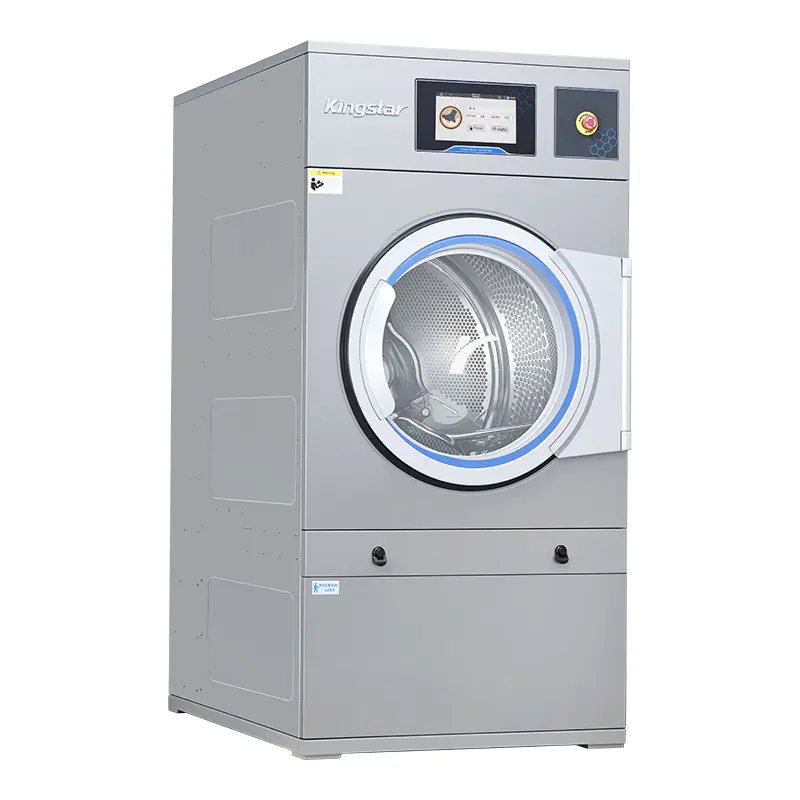
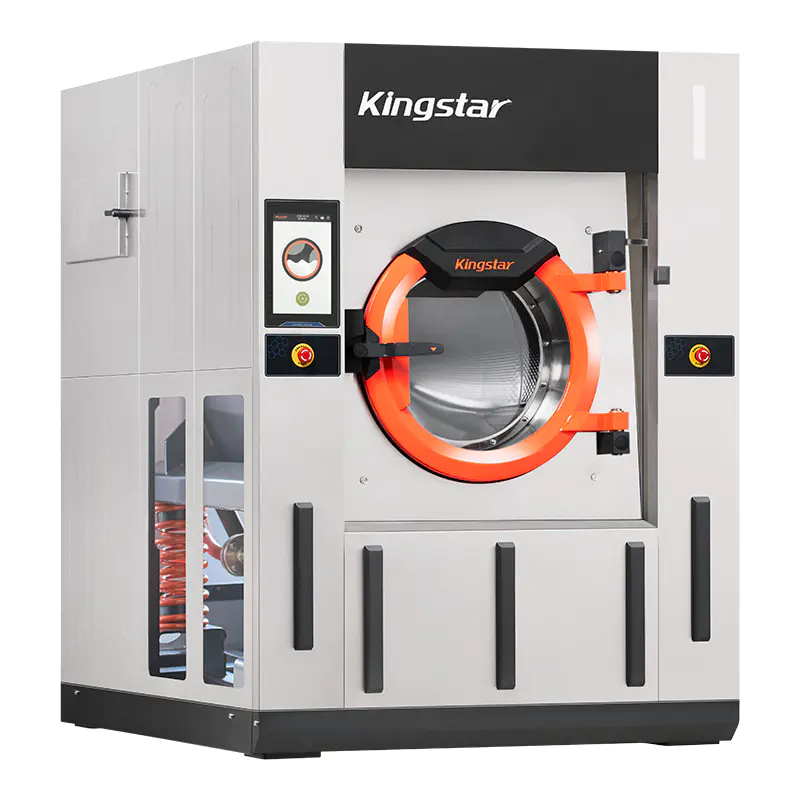
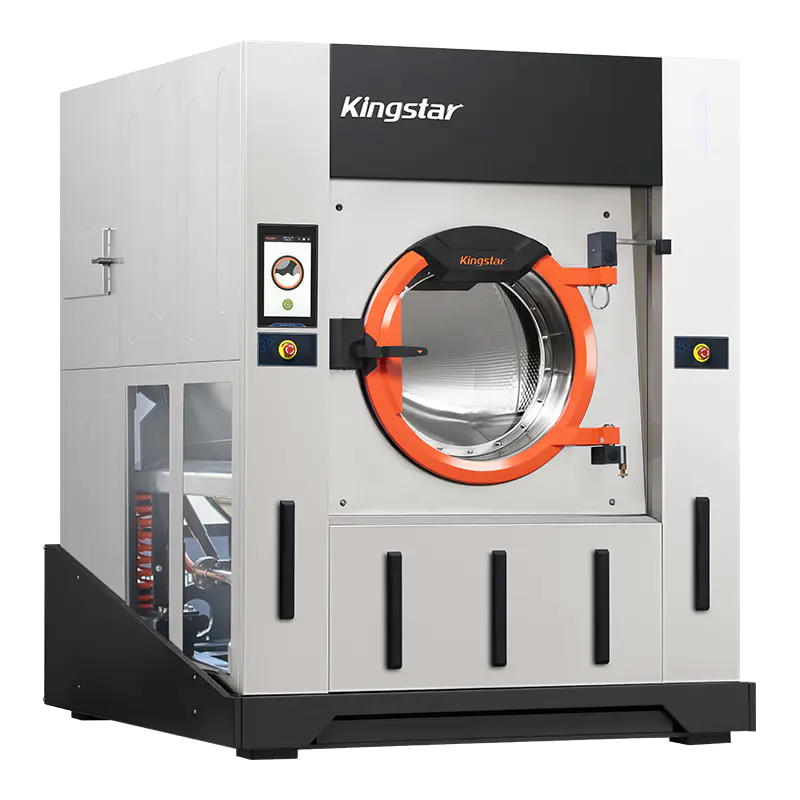
Pick a commercial dryer by matching its capacity to your washer, choosing a heat source based on existing utility infrastructure, and budgeting for energy cost rather than sticker price. Heat pump units cost more upfront but cut per-cycle energy use by up to 45% versus standard electric models. Gas-fired units offer the lowest running cost where gas lines already exist. Get those three decisions right and almost everything else about ownership — uptime, maintenance load, and cost per pound of laundry — falls into place.
A commercial dryer isn't a scaled-up version of a household machine — it's built for an entirely different duty cycle. Where a home dryer might run once or twice a day, a unit in a laundromat or hotel utility room can run continuously for 8 to 16 hours, day after day, for a decade or more.
That difference shows up in the components. Commercial drums use heavier-gauge steel and bearings rated for thousands of additional duty hours. Control boards are simplified rather than loaded with consumer smart features, since fewer electronic parts means fewer failure points under constant heat and vibration. Blower assemblies are oversized relative to drum volume, because airflow — not just heat — is what actually removes moisture from a load.
This changes how "good value" should be judged. A household dryer is evaluated on price and noise. A commercial one is evaluated on uptime, energy cost per pound of laundry processed, and whether it performs as reliably at hour ten of a long shift as it does at hour one.
The heat source is the single biggest factor in long-term cost. Each option has a distinct profile, and the right pick usually depends on what utilities are already available at the site.
| Heat Source | Cost Per Cycle | Upfront Cost | Best Fit |
|---|---|---|---|
| Standard Electric | $0.35 – $0.45 | Lowest | Sites without gas lines |
| Gas-Fired | $0.20 – $0.30 | Moderate | High-volume sites with gas infrastructure |
| Heat Pump | $0.20 – $0.25 | Highest | Long-term energy savings priority |
Gas dryers remain common in laundromats because natural gas is typically cheaper per BTU than electricity, and gas elements reach operating temperature faster, shortening the preheat portion of each cycle. The tradeoff is installation complexity — gas lines, venting, and combustion safety checks that electric units skip entirely.
Heat pump dryers work differently from both. Instead of venting hot, moist air outside and pulling in fresh air every cycle, they recirculate air in a closed loop and extract moisture from it directly. That design can cut per-cycle energy cost by up to 45% compared to a standard electric dryer. The tradeoff is a higher purchase price and, in some models, a longer cycle time.
Capacity mismatches are one of the most expensive mistakes buyers make. A dryer that's too small forces more cycles per day, adding labor time and wear. One that's too large wastes floor space and can actually hurt efficiency, since a partially filled drum tumbles unevenly and may dry a small load no faster than a properly sized one would.
The simplest rule: size dryer capacity to match or modestly exceed washer capacity. A facility running 30 lb washers generally pairs best with 30–40 lb dryers, since dried fabric is bulkier than wet fabric and needs slightly more room to tumble freely.
Overloading vs. Underloading
Overloading restricts airflow inside the drum, which extends dry time and increases energy use per load — the opposite of the intended effect. Underloading wastes available capacity, effectively running a 50 lb machine at the efficiency of a 20 lb load. Both are common, and both are fixed simply by training staff on target fill levels for each machine.
It's tempting to assume a hotter dryer dries faster. In practice, performance depends more on cubic feet per minute (CFM) of airflow than on peak temperature. Heated air has to move continuously through tumbling fabric and exit the drum carrying moisture with it. If airflow is restricted — by a clogged lint screen, an undersized duct, or too long a vent run — drying time stretches even when the heater or burner is working at full capacity.
This is also why two dryers with identical advertised temperatures can have meaningfully different cycle times. A unit with a larger blower and a short, properly sized exhaust path will consistently outperform one with a stronger heater but restricted airflow.
Maintenance on a commercial dryer isn't optional housekeeping — it's tied directly to fire risk and to the largest controllable cost in daily operation. Fire safety data makes the stakes clear.
Why Lint Maintenance Is a Safety Issue
"Failure to clean" is cited as a factor in roughly a third of all dryer fires, and dryers account for the large majority of combined washer-and-dryer home fire incidents tracked by fire safety authorities. Commercial machines run far more cycles per day than a household unit, so lint accumulates inside ducts faster — meaning the safe maintenance interval is shorter, not longer, than a typical residential recommendation.
Cleaning the lint screen after every cycle is the non-negotiable baseline. But the lint that matters most for fire risk often isn't in the screen — it's residue building up inside the exhaust duct itself, invisible during day-to-day operation.
| Task | Frequency |
|---|---|
| Clean lint screen | After every cycle |
| Check exterior vent hood for blockage | Weekly |
| Inspect belts, bearings, rollers | Quarterly |
| Professional duct and vent cleaning | Every 3–12 months, by volume |
| Full safety/combustion check (gas units) | Annually |
Purchase price is often the smallest line item in a dryer's total cost of ownership. Over an 8 to 15 year service life, energy use and maintenance dwarf the initial outlay.
Consider a six-dryer laundromat running 40 lb loads, 12 loads per day, six days a week, fifty weeks a year:
| Heat Source | Est. Cost/Cycle | Estimated Annual Energy Cost |
|---|---|---|
| Standard Electric | $0.40 | ≈ $8,640 |
| Gas-Fired | $0.25 | ≈ $5,400 |
| Heat Pump | $0.23 | ≈ $4,970 |
Over ten years, the gap between standard electric and heat pump operation in this scenario exceeds $36,000 — often enough to offset a heat pump unit's higher purchase price several times over. That's why experienced operators model lifecycle cost rather than comparing sticker prices alone.
ADD:No.388 Xinggang Road, Chongchuan District, Nantong City, 226000, Jiangsu Province, China.
Phone: +86-13917089379
Tel:+86-13917089379
Fax:+86-0513-85663366
E-mail:[email protected]
Cookies give you a personalized experience,Сookie files help us to enhance your experience using our website, simplify navigation, keep our website safe and assist in our marketing efforts. By clicking "Accept", you agree to the storing of cookies on your device for these purposes. Click "Adjust" to adjust your cookie preferences.For more information, review our Cookies Policy.