英语
英语 俄语
俄语 西班牙语
西班牙语 德语
德语
Home / News / Industry News / How Long Does a Laundromat Washing Machine Take? Standard Washers vs Washer Extractors Compared

Kingstar is your trusted partner for industrial and commercial laundry equipment. We specialized in the R&D and manufacturing of high-end industrial washers, commercial washers and dryers. Meanwhile, we provide global clients with comprehensive planning, layout workflow design, and software-hardware integration services for smart laundry plants.
Industry News
Aug 06,2026
How Long Does a Laundromat Washing Machine Take? Standard Washers vs Washer Extractors Compared
A standard laundromat washing machine typically completes a full cycle in 25 to 45 minutes depending on the wash setting, while a commercial washer extractor — the high-speed spin machines increasingly common in larger laundromats — can finish the same load in a similar wash window but leave clothes noticeably drier, cutting the following dryer cycle by as much as 20 to 30 minutes. The total time difference between the two machine types shows up mostly in the drying stage, not the washing stage, which is the detail most people overlook when they ask how long does a laundromat washing machine actually take from start to finish.
Wash Cycle Times by Machine Type
Wash time itself is fairly predictable once a cycle starts, since the timer on the door tells you exactly what to expect. But the underlying machine type changes what happens during that time, particularly in the final spin phase.
| Cycle Type | Standard Laundromat Washing Machine | Washer Extractor |
| Quick/Express wash | 15–20 minutes | 15–20 minutes |
| Normal/Regular wash | 25–35 minutes | 25–35 minutes |
| Heavy-duty wash | 35–45 minutes | 35–45 minutes |
| Final spin extraction force | Roughly 100 G-force | 200 to 450 G-force |
| Residual water left in fabric after spin | Higher | Significantly lower |
The wash duration itself barely changes between machine types — what changes is how much water remains in the load once the wash cycle ends. That single difference is the reason washer extractors have become the standard in higher-volume laundromats.
Why Washer Extractors Change the Math on Total Time
A washer extractor is a commercial washing machine built specifically to combine washing and high-speed spin extraction in one unit. During the final spin, centrifugal force — measured in G-force — pins the load against the drum wall and forces excess water out before the load ever reaches a dryer. Standard laundromat washers typically spin at speeds generating around 100 G-force, while dedicated washer extractors commonly reach 200 to 450 G-force depending on the model and mounting design.
That difference is not cosmetic. Manufacturers of high-speed extraction equipment report that moving from a standard spin to a 400+ G-force extract can cut resulting dry time by up to 50%. For a load that would normally take 40 minutes in the dryer, that can mean pulling it out in 20 to 25 minutes instead — a substantial swing when multiplied across a full laundry visit with several loads running at once.
- Soft-mount washer extractors: Allowing spin speeds up to roughly 400 G-force without needing a bolted concrete foundation.
- Hard-mount washer extractors: bolted directly to the floor, typically capped around 100 to 200 G-force, but often lower upfront cost.
- Standard top-load or front-load washers: found in smaller laundromats, generally topping out well below 100 G-force on the final spin.
Dry Cycle Times and How Machine Choice Affects Them
Drying is where the real time variation happens, and it's directly tied to how much water the washing machine removed in its final spin.
| Fabric Type | After Standard Machine Spin | After Washer Extractor Spin |
| Lightweight clothes (t-shirts, thin fabrics) | 20–30 minutes | 15–22 minutes |
| Medium-weight clothes (jeans, hoodies) | 30–40 minutes | 22–30 minutes |
| Heavy items (towels, thick cotton) | 40–50 minutes | 28–38 minutes |
| Bulky items (comforters, blankets) | 50–70 minutes | 35–50 minutes |
This is the practical answer to how long does a laundromat washing machine take when the full picture — wash plus dry — is considered: the wash stage stays roughly the same length regardless of machine type, while the dry stage can shrink by nearly a third when the washer extractor's higher G-force does more of the water removal upfront.
Total Time Spent on Common Laundry Scenarios
Putting wash and dry stages together gives a realistic sense of total time at the laundromat, comparing a facility equipped mainly with standard machines against one running washer extractors.
| Scenario | Total Time — Standard Machines | Total Time — Washer Extractors |
| Single load, everyday clothes | ~75 minutes | ~60 minutes |
| Two to three loads run simultaneously | ~90–95 minutes | ~70–80 minutes |
| Comforter or bulky blanket | ~95–100 minutes | ~75–85 minutes |
| Full household reset (5+ loads) | ~110 minutes | ~85–95 minutes |
Because loads run in parallel across multiple machines rather than one at a time, the total wall-clock time barely increases with more loads — the bigger driver of total time is which machine type is doing the spinning, not how many loads you bring in.
Load Size and Machine Capacity Also Shift the Numbers
Larger-capacity machines, whether standard washers or washer extractors, often run slightly longer wash cycles — sometimes 5 to 10 minutes more — but they process three to four times the laundry volume of a small machine in that single cycle. When measured per pound of laundry rather than per cycle, larger machines are almost always faster overall, since fewer total cycles are needed to finish the same volume of clothes.
- Small-capacity washers (roughly 20–30 lb): shorter individual cycles, but more cycles needed for a full household load.
- Mid-capacity washers (30–60 lb): the most common size in standalone laundromats, balancing cycle length and throughput.
- Large-capacity washer extractors (60 lb and above): longer per-cycle time, but capable of clearing a full family's laundry in a single run.
Ways to Reduce Total Time at the Laundromat
A few habits consistently shave time off a laundromat visit, regardless of which machine type is available:
- Pre-sort at home. Separating lights, darks, and delicates before arriving saves several minutes of sorting on-site.
- Choose the machine with the higher spin rating when given the option. If a location offers both standard washers and washer extractors, the extractor route usually finishes the full wash-and-dry process faster.
- Start all machines at once. Loading and starting every washer within a few minutes of each other keeps loads finishing around the same time.
- Transfer to the dryer immediately. Letting a spun load sit adds no benefit and can lead to odor issues.
- Avoid peak hours. Weekend late mornings and the first or last days of the month tend to have the longest machine wait times.
Situations That Take Longer Than the Averages Suggest
A few common scenarios push total time above the typical range, regardless of machine type:
- Bulky items: comforters and blankets need larger machines and significantly longer dry cycles, even with a high G-force extractor doing the wash.
- Heavily soiled clothing: the heavy-duty setting adds 10 to 15 minutes to the wash stage regardless of machine type.
- Delicate fabrics: low-heat drying settings extend dry time, since high heat isn't an option for these loads.
- Machine availability: during busy periods, waiting for an open washer or dryer can add 15 to 30 minutes before a cycle even starts, independent of how fast the equipment itself runs once it's loaded.
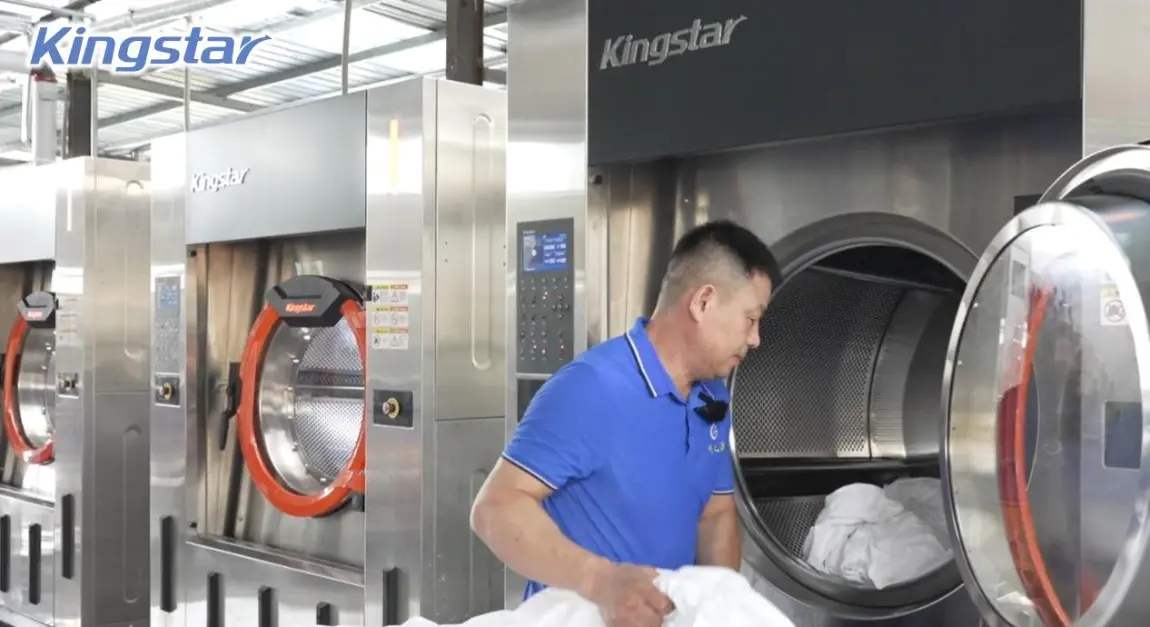
Choosing Between Machine Types Based on Your Laundry Needs
For a single light load of everyday clothes, the difference between a standard laundromat washing machine and a washer extractor is fairly small in real-world minutes. The gap widens considerably for larger, heavier, or bulkier loads, where the higher extraction force of a washer extractor meaningfully cuts down the drying stage — often the single largest time block in an entire laundry visit.
新闻2 Title: What a Laundromat Washing Machine Really Costs: Commercial Washer-Extractor Prices by Type, Capacity, and Ownership Model Keyword: commercial washing machine, commercial washer-extractor, how much is a laundromat washing machine Meta Title: How Much Is a Laundromat Washing Machine? 2026 Cost Guide Meta Description: A detailed breakdown of commercial washing machine and washer-extractor prices by type, capacity, and ownership model to help you budget accurately.
A commercial washing machine for a laundromat typically costs between $1,000 and $8,000 per unit for standard capacities, while a heavy-duty commercial washer-extractor built for high-speed extraction can run $7,000 to over $20,000 depending on capacity and mounting design. So when someone asks how much is a laundromat washing machine, the honest answer is that the sticker price depends far more on capacity, spin technology, and construction type than on any single "standard" price point — and the cheapest machine on paper isn't always the cheapest one to actually own.
Price Range by Washer Type
The mechanical design of a commercial washing machine has the single biggest impact on upfront cost, since more complex suspension and drum systems require stronger frames and motors.
| Washer Type | Typical Price Range | Key Characteristics |
| Top-load commercial washer | $800 – $2,500 | Simpler mechanics, lower upfront cost, higher water/energy use over time |
| Front-load commercial washer | $2,000 – $6,000 | Better sealing, higher spin speed, lower water use, higher upfront cost |
| Commercial washer-extractor (hard-mount) | $5,000 – $12,000 | Bolted installation, moderate G-force extraction, lower cost than soft-mount |
| Commercial washer-extractor (soft-mount) | $8,000 – $22,000+ | Internal suspension, no concrete bolting needed, highest extraction speeds |
Top-load machines remain cheaper to buy, but most modern laundromats now lean toward front-load and washer-extractor units for their higher spin speeds, which cut drying time and reduce long-term utility costs enough to offset the higher purchase price within a few years of steady use.
Price by Load Capacity
Capacity, measured in pounds of dry laundry per cycle, is the second-biggest cost driver. Larger drums require heavier steel, bigger motors, and reinforced frames, all of which raise manufacturing cost.
| Capacity Range | Typical Price | Common Setting |
| 10 – 25 lb | $1,000 – $3,000 | Small laundromats, apartment laundry rooms |
| 30 – 50 lb | $3,000 – $7,500 | Standard laundromats and hotel on-site laundry |
| 60 lb and up | $7,000 – $20,000+ | High-volume laundromats, large hospitality operations |
Buying a machine larger than needed wastes water, electricity, and floor space on underloaded cycles, while an undersized machine leads to overloading and premature wear. Estimating realistic daily laundry volume before choosing capacity avoids both mistakes.
New vs Used: What the Price Difference Actually Buys
Used commercial washing machines can cost roughly half of a comparable new unit, but the savings come with real trade-offs.
- New machines: full manufacturer warranty, current energy-efficiency ratings, and a full expected lifespan of 10 to 15 years or 5,000 to 8,000 cycles.
- Used machines: lower upfront cost, but typically no warranty, reduced remaining lifespan, and a real risk of inheriting undisclosed wear or prior repair issues.
A used machine bought at 50% of new price but with only a third of its service life remaining rarely ends up cheaper per year of operation — the math only works out when the used unit comes from a reputable refurbisher who backs the sale with some form of guarantee.
How Mounting Design and Extraction Speed Change the Price
Within the commercial washer-extractor category specifically, the mounting design has a large effect on both price and installation requirements.
| Feature | Hard-Mount Extractor | Soft-Mount Extractor |
| Installation requirement | Must be bolted to a reinforced concrete pad | Internal spring suspension absorbs vibration, no bolting needed |
| Typical extraction G-force | 100 – 200 G | 200 – 450 G |
| Relative purchase price | Lower | Higher (often 20–40% more) |
| Installation cost impact | Higher, due to concrete work | Lower, since no foundation modification is required |
A soft-mount commercial washer-extractor often costs more at purchase but less overall once installation and dry-time energy savings are factored in, particularly for locations without an existing reinforced floor pad.
Installation and Setup Costs That Add to the Sticker Price
The machine price is rarely the full cost of getting a washer running. Installation typically adds:
- Professional installation: roughly $500 to $1,500 per machine for standard hookups.
- Delivery charges: an additional $250 to $700 per machine depending on distance and access.
- Site modifications: concrete pad pouring for hard-mount extractors, electrical panel upgrades, or plumbing changes can add several hundred to a few thousand dollars depending on the building's existing infrastructure.
Skipping these line items when budgeting is one of the most common reasons operators are surprised by the real total when equipping a new laundromat.
Financing and Leasing vs Buying Outright
Few laundromat operators pay the full machine price upfront. Financing and leasing spread the cost into predictable monthly payments.
| Ownership Model | Typical Monthly Cost | Trade-off |
| Buy outright | N/A (one-time cost) | Lowest total cost over time, machine becomes a resellable asset |
| Finance (loan) | $100 – $500 per machine | Spreads cost, but adds interest over the loan term |
| Lease | Similar monthly range, often slightly higher | Little to no upfront cost, but higher total cost and no equity built |
For a laundromat generating daily revenue from the same machines being financed, buying often makes more sense long-term, since the income stream can cover loan payments while the machine still becomes a fully owned asset once paid off.
Total Cost of Ownership Over the Machine's Lifespan
The purchase price is only one part of the real cost equation. A complete total cost of ownership calculation includes:
- Annual maintenance: typically $500 to $1,500 per machine, or roughly 3% to 5% of purchase price per year.
- Utility costs: water, gas, and electricity, which can run 20% to 25% of a laundromat's gross revenue.
- Expected lifespan: 10 to 15 years, or 5,000 to 8,000 wash cycles, for a well-maintained commercial machine.
- Warranty coverage: some manufacturers offer extended coverage — occasionally up to 10 years — on core components like the drum, which meaningfully lowers long-term repair risk.
A machine priced 20% higher but rated for 40% lower water use, or backed by a significantly longer warranty on major components, frequently ends up cheaper across its full working life than the lowest-priced option on the showroom floor.
Budgeting Realistically for a New or Growing Laundromat
Putting the full picture together — machine price, capacity, mounting type, installation, and ownership model — gives a far more accurate answer to how much is a laundromat washing machine than the purchase price alone. A single mid-capacity front-load unit might land around $4,000, but once installation, financing structure, and a decade of utility and maintenance costs are added, the real multi-year investment per machine is typically several times the original sticker figure.
新闻3 Title: The Laundromat Isn't Complicated — You Just Missing a Few Details Keyword: washer and dryer, double stack dryer, how to use laundromat washing machine Meta Title: How to Use a Laundromat Washing Machine: A Practical Guide Meta Description: A no-nonsense guide to using laundromat washers and dryers, including how single and double stack dryers actually compare in real time savings.
Using a laundromat washing machine comes down to four things: sort your clothes by weight and fabric before you leave home, pick a machine sized to your load rather than the nearest empty one, choose water temperature based on fabric type rather than habit, and move your load to the dryer the moment it stops spinning. Skip any one of these steps and you'll either waste money on a half-empty cycle or end up rewashing something that didn't come out clean. Everything else — etiquette, folding, dryer settings — builds on getting these four right.
01What to Pack Before You Even Leave the House
A rough trip to the laundromat almost always starts at home, not on-site. Forgetting detergent means paying laundromat markup for a tiny box; forgetting quarters means standing at a change machine while your neighbor grabs the last open washer. A five-minute pack-up avoids both.
| Item | Why It Matters |
| Payment — cash, card, or app | Some locations still run coin-only machines; carrying both avoids getting stuck |
| Detergent (pods preferred) | No measuring, no spills, and you control what actually touches your clothes |
| Mesh bags for delicates | Keeps thin fabric from snagging on zippers or drum seams during the spin cycle |
| Separate bags by category | Presorting at home turns loading machines into a two-minute task, not ten |
| Stain stick or pen | Fresh spots caught before the wash come out far more easily than ones set by heat later |
02Claiming Space and Doing the Two-Second Machine Check
Walk in, find a folding table or an open counter, and set your bags down — that's your base for the next hour. Before loading anything, open the washer door and take a quick sniff. It sounds trivial, but a machine that just finished someone's bleach-heavy load or a smoke-saturated jacket can leave a smell behind that transfers straight onto your clean clothes. Ten seconds of checking saves an entire rewash.
20–30% lower water and energy cost per visit when loads are properly presorted before washing
03Sorting That Goes Beyond Light and Dark
Most people learned to separate whites from colors and stopped there. That's a start, not the finish line. Grouping by fabric weight matters just as much, since a load mixing heavy towels with a thin blouse means one item finishes drying while the other is still damp twenty minutes later.
- Lights and whites: t-shirts, underwear, socks — the basics that can handle warmer water without fading.
- Darks and colors: jeans and anything vividly dyed; cold water keeps color loss to a minimum.
- Delicates: lace, silk, thin knits — these belong in a mesh bag on a gentle cycle, full stop.
- Heavy items: towels, bedding, hoodies — these soak up more water and need a stronger cycle to actually get clean.
Before bagging anything up, run through pockets, zippers, and buttons. A forgotten pen ruins an entire load; an open zipper snags on everything nearby; a buttoned shirt strains its own buttonholes during agitation. None of this takes more than a minute, and all of it prevents a bad surprise thirty minutes into a cycle.
04How to Use a Laundromat Washing Machine Step by Step
Once sorting is done, actually running the machine is the simplest part — provided you match the load to the right size unit first.
- Choose a machine sized close to your load — filling the drum about three-quarters full gives clothes room to tumble and lets water reach every item.
- Load the clothes loosely rather than packing them down; a drum that's too tight can't agitate properly, and soap won't reach fabric buried in the middle.
- Add detergent to the dispenser tray, not directly on top of clothes, unless the machine specifically calls for it.
- Select water temperature based on fabric type, not habit — see the breakdown below.
- Start the cycle and note the finish time so you're back before it ends, not after someone else has moved your wet clothes for you.
| Load Size | Typical Machine Size | Best Fit For |
| 10–15 lb | Small top-loader or compact front-loader | A few outfits, a week of delicates |
| 20–30 lb | Standard front-loader | A full hamper of everyday clothes |
| 40 lb and up | Large-capacity front-loader | Comforters, sleeping bags, family-sized loads |
05Water Temperature and Cycle Settings, Decoded
A machine panel with six buttons and three dials looks more intimidating than it is. Hot water, generally around 130°F, lifts noticeably more soil from whites, towels, and bedding, and does double duty by sanitizing at the same time. Cold water is the safer default for anything with color or elastic, since heat is what causes both fading and shrinkage. Most modern laundromat washers also use meaningfully less water per cycle than an older home machine would, which is worth knowing if cost per load factors into your decision on which location to use.
06Single Dryers vs Double Stack Dryers: What Actually Changes
Once the wash is done, the dryer you pick affects your timeline as much as the washer did. A double stack dryer holds two separate drying pockets in one cabinet, each with its own controls, sharing a single gas line and exhaust connection. Functionally, that means two loads can run on different heat settings and different timers at the same time, in the exact same footprint a single large dryer would occupy.
| Feature | Standard Single Dryer | Double Stack Dryer |
| Number of independent loads at once | One | Two, each on its own timer and heat setting |
| Floor space needed for two loads | Two full machine footprints | One machine footprint |
| Typical cycle length | 20–60 minutes depending on fabric and load | Same range per pocket, running independently |
| Best fit | Single large or bulky load (comforters, sleeping bags) | Two mixed loads — say, towels in one pocket, everyday clothes in the other |
For a shopper juggling two loads with different fabric needs — heavy towels that want high heat, delicates that want low heat — a double stack dryer means both finish around the same time without hogging two separate machines. A single large-capacity dryer still wins for one oversized item like a king comforter, where more interior drum space matters more than running two things independently.
07Drying Settings That Prevent Shrinking and Wrinkling
Before loading anything, clean the lint filter — every time, even if it looks nearly empty. A clogged filter chokes airflow, stretches drying time, and is a genuine fire risk. Then match the heat setting to the fabric rather than defaulting to high:
- High heat: denim, thick towels, bedding — anything dense enough to need real heat to push moisture out.
- Medium heat: everyday t-shirts and synthetic blends — effective without over-stressing the fabric.
- Low heat: gym wear, lingerie, anything with stretch or delicate seams.
- Air fluff, no heat: pillows, down jackets, or anything you just want de-wrinkled rather than dried.
Pulling clothes out slightly damp and letting them finish air-drying does less fabric damage than running a longer cycle to force bone-dry results — over-drying is the single biggest cause of faded color and wrinkles that won't shake out. And once the dryer stops, fold immediately. Warm clothes left sitting in a pile invite wrinkles that a few extra minutes at the folding table would have prevented entirely.
08Etiquette and Safety Basics Worth Knowing
A laundromat is a shared space, and a few habits keep it running smoothly for everyone using the washer and dryer at the same time as you. Be back before your cycle ends — set a phone timer with a couple of minutes to spare. Wipe up spilled detergent, toss used dryer sheets in the trash, and use the cart only as long as you actually need it. If a finished load has clearly been abandoned for a while, it's fine to move it to a clean cart or table — never onto the floor.
On the safety side, pick a location that's well-lit with visible cameras, note where the exits are, and keep your phone, wallet, and bag with you rather than left unattended on a table across the room. None of this requires much thought once it becomes routine — which, for most people, takes about one visit to figure out.
新闻4 Title: Buying a Commercial Dryer? The Capacity Math Matters More Than the Price Tag Keyword: commercial dryer, commercial washer-extractor Meta Title: Commercial Dryer Buying Guide: Sizing, Gas vs Electric, Features Meta Description: A practical comparison of commercial dryer capacity, gas vs electric costs, and pairing with a washer-extractor to cut drying time and energy waste.
The right commercial dryer isn't the biggest one on the floor — it's the one sized to match what your washer actually processes each day. Undersize it and laundry backs up behind a bottleneck; oversize it and you're heating an half-empty drum on every cycle, burning gas or electricity for nothing. Getting that match right, along with choosing gas or electric correctly for your utility setup, matters more to your long-term operating cost than almost any other single decision in the buying process.
Start With Real Laundry Volume, Not a Guess
Before comparing a single model, figure out how many pounds of laundry your operation actually generates on a typical day — and on your busiest one. A single occupied hotel room, for example, commonly produces somewhere between 6 and 12 pounds of laundry daily. Scale that across a 50-room property running near full occupancy, and you're looking at north of 500 pounds of towels and sheets needing to be dried in a single day.
The capacity math that follows from this is simple but frequently ignored: dryer capacity should run roughly 1.5 to 2 times your washer's rated load size, giving clothes enough room to tumble freely and air to circulate properly. A 40-pound washer pairs well with a 50- to 75-pound dryer — pairing it with something smaller creates a permanent drying bottleneck no matter how efficient the washer itself is.
1.5–2x recommended dryer capacity relative to washer load size
500+ lb daily laundry volume for a mid-size hotel at near-full occupancy
6–12 lb laundry generated per occupied hotel room, per day
Why a Residential Dryer Doesn't Belong in a Commercial Setting
It's tempting to save money by picking up a big-box residential dryer instead of a purpose-built commercial dryer, and it's almost always a costly mistake once daily-use math kicks in.
| Factor | Residential Dryer | Commercial Dryer |
| Rated operating life | Roughly 2,500 hours | Roughly 30,000 hours — about 12 times longer |
| Motor, belt, and bearing build | Built for occasional home use | Built for continuous, all-day cycling |
| Warranty in commercial use | Typically voided outright | Valid — built and rated specifically for it |
A machine rated for occasional home laundry simply wasn't engineered to run back-to-back cycles ten or twelve hours a day. Once it fails — and it typically does, well before a commercial-rated unit would — you're not just facing a repair bill, you're facing it with no warranty coverage to fall back on.
Gas or Electric: Where the Real Cost Difference Shows Up
Heat source is the single biggest fork in the road when specifying a commercial dryer, and the two options split cleanly on upfront cost versus running cost.
- Gas dryers heat faster and typically cost less to run — one commonly cited comparison puts annual energy cost around $290 for a gas unit versus roughly $520 for a similarly sized electric model. The trade-off is a higher purchase price and the need for a professional gas line hookup plus proper exhaust venting.
- Electric dryers install more simply wherever adequate voltage (usually 208–240V) is already available, and cost less upfront. Running cost per load tends to be higher, which matters more the higher your daily cycle count climbs.
For a business running dryers most of the day, every day, the gas option's lower operating cost usually overtakes its higher purchase price within a couple of years. For lower-volume operations where a gas line isn't already in the building, electric remains the more practical starting point.
Features That Actually Justify a Higher Price
Not every added feature on a spec sheet pays for itself, but a few genuinely do.
- Reversing drum: periodically changes rotation direction so sheets and large linens don't twist into a single dense ball, letting hot air reach fabric evenly and cutting overall dry time.
- Moisture sensors: shut the cycle off the moment laundry is actually dry instead of running a fixed timer, which prevents over-drying — a habit that quietly shortens fabric life and wastes energy on every load that finishes early but keeps tumbling anyway.
- Pairing with a high-extraction washer-extractor: this is the feature most operators overlook, even though it affects the dryer more than any onboard dryer feature does. A commercial washer-extractor spinning at 300+ G-force pulls dramatically more water out of a load before it ever reaches the dryer, which shortens the drying cycle that follows regardless of how advanced the dryer itself is.
How Washer-Extractor Spin Speed Changes Dryer Workload
This pairing deserves its own breakdown, since a commercial dryer's real-world performance depends heavily on how wet the load already is when it arrives.
| Upstream Washer Type | Typical Extraction Force | Effect on Dryer Cycle |
| Standard commercial washer | Around 100 G-force | Longer dry times, higher gas or electric draw per load |
| Commercial washer-extractor | 200 to 450 G-force depending on mount design | Noticeably shorter dry cycles, lower per-load energy use |
In practice, this means a facility that upgrades its washing equipment to a higher-extraction commercial washer-extractor often sees its existing dryer fleet run faster cycles without touching a single dryer setting — the water simply isn't there to remove in the first place.
Getting the Machine Through the Door — Literally
Commercial dryers are large, heavy, and unforgiving of last-minute measurement mistakes. A common 50-pound gas unit can run roughly 34.5 inches wide and 72 inches tall — dimensions that catch plenty of buyers off guard when the delivery crew reaches a standard interior doorway.
- Measure every doorway, hallway turn, and stairwell along the actual delivery path before ordering, not after.
- Account for the clearance a dolly or pallet jack needs, not just the machine's own footprint.
- Where site access is tight, a professional delivery and placement service — sometimes called white-glove delivery — handles uncrating and positioning, which is usually worth the added fee compared to a failed delivery attempt.
Financing the Purchase Without Draining Cash Reserves
A commercial dryer is a meaningful capital expense, and most businesses don't pay for one outright. Close to eight in ten U.S. businesses use some form of financing for equipment purchases like this, spreading the cost into a predictable monthly payment instead of a single large outlay. Done right, the efficiency gains from a properly sized, well-featured dryer start offsetting that monthly payment almost immediately through lower utility bills and reduced staff time spent babysitting slow-drying loads.
What a Warranty Actually Needs to Cover
Purchase price tells only part of the story — long-term support matters just as much once the machine is running daily cycles. When comparing options, look specifically for:
- Multi-year coverage on core components — heating elements, drum bearings, and motors are the parts most likely to fail under heavy use.
- Separate, shorter coverage windows for general parts is normal, but core components deserve the longest protection.
- Access to responsive technical support — a machine down for days while waiting on a callback costs far more in lost laundry throughput than most people initially budget for.
A dryer bought slightly cheaper but backed by weaker warranty terms often ends up the more expensive choice once a single major component fails outside of coverage — the sticker price was never the whole cost equation to begin with.
新闻5 Title: Where Commercial Ends and Industrial Begins: A Capacity-by-Capacity Look at Heavy-Duty Laundry Equipment Keywords: industrial washing machines, hotel washing machine Meta Title: Industrial Washing Machines vs Commercial: Capacity & Features Meta Description: A data-driven comparison of industrial washing machines and hotel washing machine needs, covering capacity, extraction speed, and durability.
Industrial washing machines exist for one reason: volume that a standard commercial washer simply can't absorb. Where a commercial unit tops out somewhere around 75 pounds per load, industrial models are built to process 200 pounds or more in a single cycle, with reinforced drums and drive systems designed to run that hard for years without slowing down. A busy hotel washing machine setup usually sits right at this dividing line — the exact point where daily linen volume decides whether commercial-grade equipment is still enough, or whether it's time to size up.
ComparisonCommercial vs Industrial: Where the Line Actually Sits
The two categories get lumped together constantly, but they're built for genuinely different jobs — closer to comparing a delivery van with a semi-truck than comparing two versions of the same thing.
| Factor | Commercial Washing Machine | Industrial Washing Machine |
| Typical load capacity | 15 – 75 lb | 200 lb and up |
| Drum and frame material | Durable, but standard-grade construction | All stainless steel drums, reinforced frames |
| Typical daily usage pattern | Steady, moderate volume | Continuous, near-nonstop operation |
| Control complexity | User-friendly, general-purpose cycles | Programmable cycles for disinfection, hazardous-material cleaning |
| Rated cycle life | Around 10,000 cycles | 30,000 cycles or more |
DataLoad Capacity, Visualized
Numbers on a spec sheet are easy to skim past. Seeing the actual gap side by side makes the decision clearer.
HospitalityWhat a Hotel Washing Machine Setup Actually Needs to Handle
Hotels are a good real-world test case for this whole capacity question, since the daily volume is easy to estimate and scales predictably with occupancy. A single occupied room typically generates somewhere between 6 and 12 pounds of laundry a day between sheets, towels, and linens. A 50-room property running close to full occupancy is easily clearing 500-plus pounds a day — a volume that starts pushing past what a single commercial washer, or even two, can comfortably absorb without long queues between cycles.
This is exactly why larger hotels and resorts tend to graduate from a commercial hotel washing machine setup to genuine industrial equipment once room count and occupancy climb high enough. A single 200-pound industrial load can clear what would otherwise take two or three separate commercial cycles, cutting both labor time and total water use per pound of laundry processed.
ExtractionHigh-Speed Extraction and Why the G-Force Number Matters
Extraction is the spin phase that forces water out of laundry using centrifugal force, and it's measured in G-force. A typical home washer manages around 100 G; a commercial or industrial washing machine can reach 280 to 450 G depending on mounting design. That difference isn't cosmetic — pushing extraction into that higher range can remove close to 40% of the residual moisture that would otherwise still be sitting in the fabric heading into the dryer, which directly shortens dry time and cuts the energy spent getting a load fully dry.
SanitationSteam Injection and Why It Matters More in Some Settings Than Others
Steam injection pushes hot vapor directly into the wash drum, and it does two things a standard wash cycle can't quite match. First, the smaller vapor molecules penetrate fabric fibers more thoroughly than plain water, which helps break down grease and oil-based stains that resist a standard rinse. Second, steam running above 212°F is genuinely effective at killing bacteria, viruses, and common allergens like dust mites — which is exactly why the feature shows up so consistently on industrial washing machines destined for hospitals, clinics, and any hospitality operation that treats sanitation as a compliance issue rather than a nice-to-have.
InstallationHard-Mount vs Soft-Mount: The Installation Question Nobody Budgets For
Space planning for an industrial washing machine goes well beyond the machine's footprint. Traditional hard-mount designs need a dedicated ground-floor room with a reinforced concrete foundation, since the machine has to be bolted down to control vibration during high-speed spin cycles.
- Hard-mount machines: lower purchase price, but require concrete anchoring and are generally limited to ground-floor placement.
- Soft-mount machines: use an internal suspension system that absorbs vibration internally, allowing a simpler drop-and-go installation — including on upper floors where a reinforced foundation isn't available.
Measuring doorways, hallway turns, and delivery paths before ordering is just as important as choosing between mount types — a machine that can't physically reach its intended room is a logistics problem no spec sheet will warn you about.
Use CasesWho Actually Relies on Industrial Washing Machines
Beyond hospitality, a few other industries depend on this equipment just as heavily, each for slightly different reasons.
- Healthcare: hospitals and nursing homes often run barrier washers built directly into a wall, physically separating soiled linens from clean output to prevent cross-contamination — a setup that pairs steam injection and automated disinfectant dosing with strict infection-control requirements.
- Manufacturing: factories use heavy-duty cycles to clean oil-soaked rags, work uniforms, and protective gear on-site, which keeps control in-house and is generally cheaper than outsourcing to an external laundry service.
- Food processing: plants rely on sanitizing cycles to keep aprons and gowns compliant with health codes, where a missed sanitation step isn't just a quality issue but a regulatory one.
LongevityDurability, Cycle Life, and What a Warranty Should Actually Cover
A commercial washer might be rated around 10,000 cycles over its working life. An industrial washing machine is often built to handle 30,000 cycles or more — theoretically enough for eight cycles a day, every day, for roughly a decade without the core components giving out. That kind of longevity comes down to construction: high-grade stainless steel drums, reinforced frames, and drive systems built to shrug off continuous heavy loads rather than occasional home use.
When comparing warranty terms between models, the details that matter most are multi-year coverage on the drum and frame specifically, since those are the components most exposed to stress over tens of thousands of cycles — a warranty that's generous on minor parts but thin on the drum itself isn't protecting the part of the machine most likely to eventually need it.
ADD:No.388 Xinggang Road, Chongchuan District, Nantong City, 226000, Jiangsu Province, China.
-
Phone: +86-13917089379
-
Tel:+86-13917089379
-
Fax:+86-0513-85663366
-
E-mail:louislu@kingstarlaundry.com
products