英语
英语 俄语
俄语 西班牙语
西班牙语 德语
德语
Home / News / Industry News / Where Commercial Ends and Industrial Begins: A Capacity-by-Capacity Look at Heavy-Duty Laundry Equipment

Kingstar is your trusted partner for industrial and commercial laundry equipment. We specialized in the R&D and manufacturing of high-end industrial washers, commercial washers and dryers. Meanwhile, we provide global clients with comprehensive planning, layout workflow design, and software-hardware integration services for smart laundry plants.
Industry News
Sep 03,2026
Where Commercial Ends and Industrial Begins: A Capacity-by-Capacity Look at Heavy-Duty Laundry Equipment
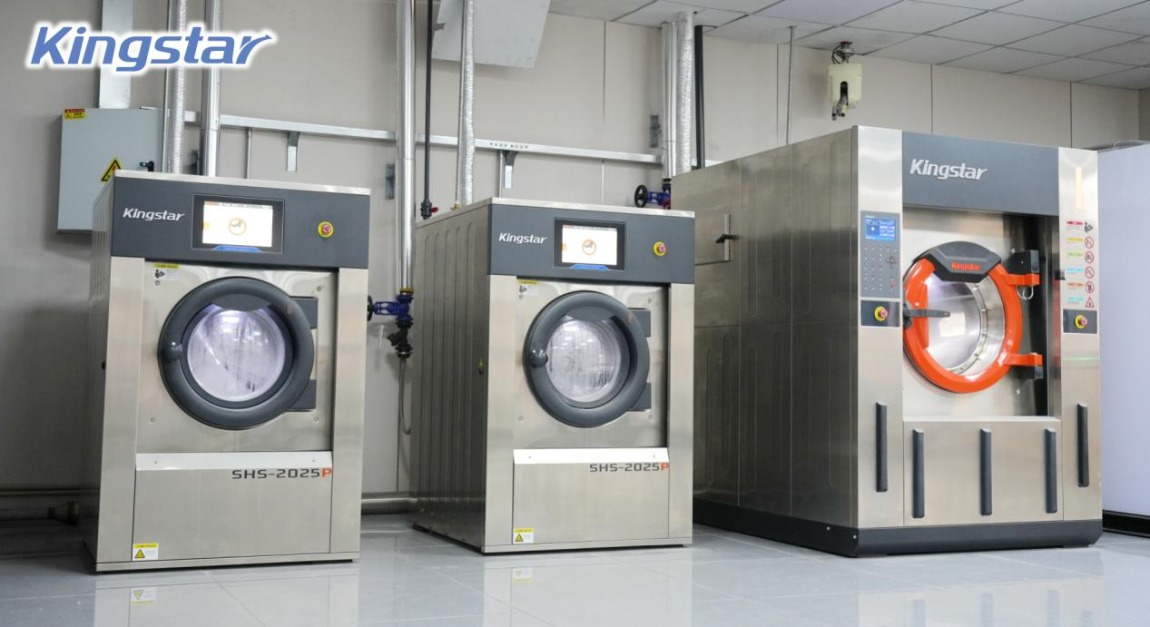
Industrial washing machines exist for one reason: volume that a standard commercial washer simply can't absorb. Where a commercial unit tops out somewhere around 75 pounds per load, industrial models are built to process 200 pounds or more in a single cycle, with reinforced drums and drive systems designed to run that hard for years without slowing down. A busy hotel washing machine setup usually sits right at this dividing line — the exact point where daily linen volume decides whether commercial-grade equipment is still enough, or whether it's time to size up.
ComparisonCommercial vs Industrial: Where the Line Actually Sits
The two categories get lumped together constantly, but they're built for genuinely different jobs — closer to comparing a delivery van with a semi-truck than comparing two versions of the same thing.
| Factor | Commercial Washing Machine | Industrial Washing Machine |
| Typical load capacity | 15 – 75 lb | 200 lb and up |
| Drum and frame material | Durable, but standard-grade construction | All stainless steel drums, reinforced frames |
| Typical daily usage pattern | Steady, moderate volume | Continuous, near-nonstop operation |
| Control complexity | User-friendly, general-purpose cycles | Programmable cycles for disinfection, hazardous-material cleaning |
| Rated cycle life | Around 10,000 cycles | 30,000 cycles or more |
DataLoad Capacity, Visualized
Numbers on a spec sheet are easy to skim past. Seeing the actual gap side by side makes the decision clearer.
HospitalityWhat a Hotel Washing Machine Setup Actually Needs to Handle
Hotels are a good real-world test case for this whole capacity question, since the daily volume is easy to estimate and scales predictably with occupancy. A single occupied room typically generates somewhere between 6 and 12 pounds of laundry a day between sheets, towels, and linens. A 50-room property running close to full occupancy is easily clearing 500-plus pounds a day — a volume that starts pushing past what a single commercial washer, or even two, can comfortably absorb without long queues between cycles.
This is exactly why larger hotels and resorts tend to graduate from a commercial hotel washing machine setup to genuine industrial equipment once room count and occupancy climb high enough. A single 200-pound industrial load can clear what would otherwise take two or three separate commercial cycles, cutting both labor time and total water use per pound of laundry processed.
ExtractionHigh-Speed Extraction and Why the G-Force Number Matters
Extraction is the spin phase that forces water out of laundry using centrifugal force, and it's measured in G-force. A typical home washer manages around 100 G; a commercial or industrial washing machine can reach 280 to 450 G depending on mounting design. That difference isn't cosmetic — pushing extraction into that higher range can remove close to 40% of the residual moisture that would otherwise still be sitting in the fabric heading into the dryer, which directly shortens dry time and cuts the energy spent getting a load fully dry.
SanitationSteam Injection and Why It Matters More in Some Settings Than Others
Steam injection pushes hot vapor directly into the wash drum, and it does two things a standard wash cycle can't quite match. First, the smaller vapor molecules penetrate fabric fibers more thoroughly than plain water, which helps break down grease and oil-based stains that resist a standard rinse. Second, steam running above 212°F is genuinely effective at killing bacteria, viruses, and common allergens like dust mites — which is exactly why the feature shows up so consistently on industrial washing machines destined for hospitals, clinics, and any hospitality operation that treats sanitation as a compliance issue rather than a nice-to-have.
InstallationHard-Mount vs Soft-Mount: The Installation Question Nobody Budgets For
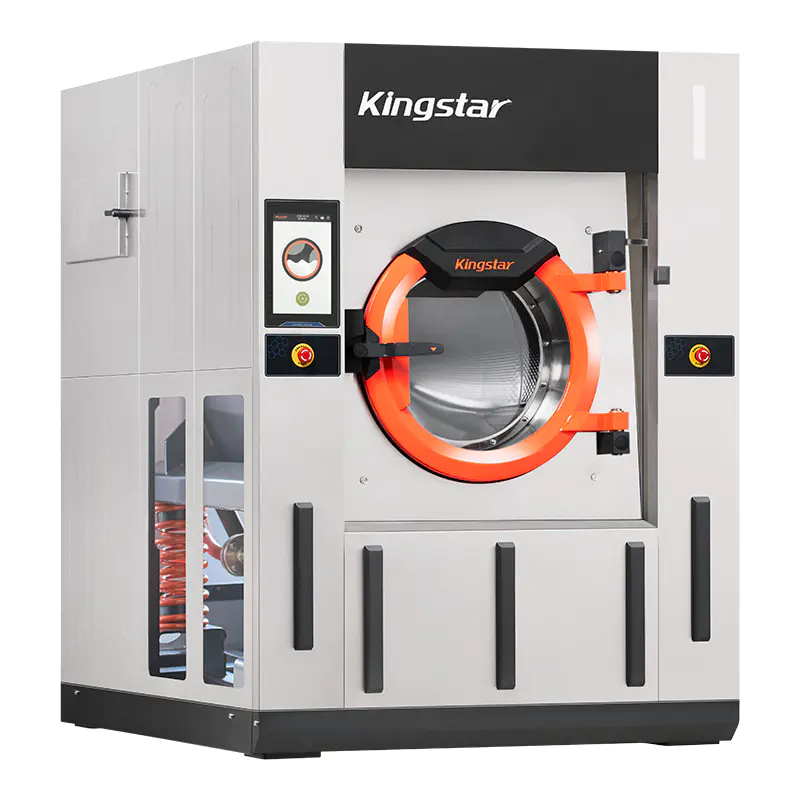
Space planning for an industrial washing machine goes well beyond the machine's footprint. Traditional hard-mount designs need a dedicated ground-floor room with a reinforced concrete foundation, since the machine has to be bolted down to control vibration during high-speed spin cycles.
- Hard-mount machines: lower purchase price, but require concrete anchoring and are generally limited to ground-floor placement.
- Soft-mount machines: use an internal suspension system that absorbs vibration internally, allowing a simpler drop-and-go installation — including on upper floors where a reinforced foundation isn't available.
Measuring doorways, hallway turns, and delivery paths before ordering is just as important as choosing between mount types — a machine that can't physically reach its intended room is a logistics problem no spec sheet will warn you about.
Use CasesWho Actually Relies on Industrial Washing Machines
Beyond hospitality, a few other industries depend on this equipment just as heavily, each for slightly different reasons.
- Healthcare: hospitals and nursing homes often run barrier washers built directly into a wall, physically separating soiled linens from clean output to prevent cross-contamination — a setup that pairs steam injection and automated disinfectant dosing with strict infection-control requirements.
- Manufacturing: factories use heavy-duty cycles to clean oil-soaked rags, work uniforms, and protective gear on-site, which keeps control in-house and is generally cheaper than outsourcing to an external laundry service.
- Food processing: plants rely on sanitizing cycles to keep aprons and gowns compliant with health codes, where a missed sanitation step isn't just a quality issue but a regulatory one.
LongevityDurability, Cycle Life, and What a Warranty Should Actually Cover
A commercial washer might be rated around 10,000 cycles over its working life. An industrial washing machine is often built to handle 30,000 cycles or more — theoretically enough for eight cycles a day, every day, for roughly a decade without the core components giving out. That kind of longevity comes down to construction: high-grade stainless steel drums, reinforced frames, and drive systems built to shrug off continuous heavy loads rather than occasional home use.
When comparing warranty terms between models, the details that matter most are multi-year coverage on the drum and frame specifically, since those are the components most exposed to stress over tens of thousands of cycles — a warranty that's generous on minor parts but thin on the drum itself isn't protecting the part of the machine most likely to eventually need it.
ADD:No.388 Xinggang Road, Chongchuan District, Nantong City, 226000, Jiangsu Province, China.
-
Phone: +86-13917089379
-
Tel:+86-13917089379
-
Fax:+86-0513-85663366
-
E-mail:louislu@kingstarlaundry.com
products